
Delivering 7 Days a Week - Illawarra Wide - $19.95
Order by 1pm for Same Day Delivery
Call Us
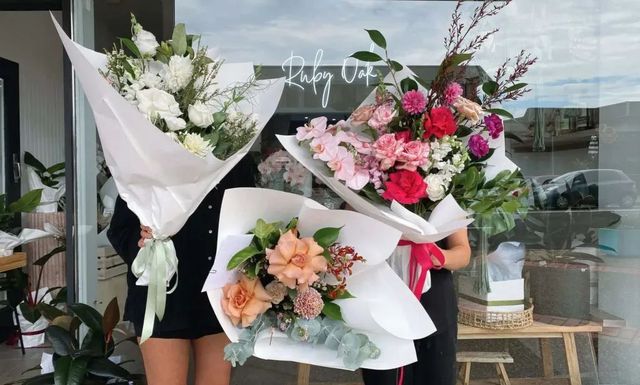
At Ruby Oak Floristry, we truly love our flowers! And we are lucky enough to get to touch and smell them every day. Our friends and customers often ask us about our favourite flowers. That’s such a difficult question to answer. For us, every flower has so much beauty and appeal and can look so different in the various arrangements we make.
Adele and I still get excited when new colours and varieties of flowers come into season and into our shop! Sometimes it’s the pure magnificence of a large stem of phalaenopsis orchid combined with a large tropical leaf that sets our hearts fluttering. Or on another day, we take delivery of the most amazing and delicately shaded ranunculus, snapdragons, Lisianthus or anemones. A big favourite are poppies still in bud that we watch unfurl over the day. None of us ever get tired of the massively tall blue and purple delphiniums, or the Pink Floyd roses in a ‘Pop of Colour’ or ‘Pink Love’ bouquet.
Art and Flowers
Lately I’ve been looking at paintings that show flowers as fantastic objects of beauty and wonder and was blown away by the Cressida Campbell exhibition in Canberra. I’m looking forward to seeing the Monet & Friends Alive exhibition at The Lume in Melbourne, showcasing the life and vibrant works of Monet, Cézanne, Renoir, and Manet.
Saying it with flowersFlowers have for so long been sent as tokens of love and affection, and displayed as symbols of celebration and remembrance. The start of the COVID pandemic was the time when we started Ruby Oak Floristry, and a time when sending flowers became one of the only ways for people to connect with our friends and family to say ‘Happy Birthday,’ I’ Love You’ , ‘Missing You’ or Congratulations’.
From the perfect floral arbour for a wedding, a beautiful bouquet for a birthday, a message of thanks, or to pay one’s respect at a funeral, flowers have long been such an important part of human culture.
But, while everyone knows that red roses signify love, how many of you know that an entire language of flowers exists with every bloom, foliage and plant having a particular emotion attached, for example wisteria for ‘welcome’ or ivy for ‘fidelity’?
The language of flowers was historically used as a means of secret communication by the romantic early Victorians (early 1900’s). It soared in popularity during the 19th century, especially in Victorian England and the U.S., when proper etiquette discouraged open displays of emotion. It was common for them to carefully plan every bouquet and posy to deliver a message. Flowers were used to send mysterious and playful messages of love and friendship, thoughtful messages of sympathy and grief, and even darker communications signifying bitter endings of relationships or jealousy.
Imagine receiving a beautiful bouquet and having to reach for your handy flower meaning guide (or Floriography) to work out what the message was!
In the Victorian language of flowers, hundreds of blooms were ascribed specific meanings based on folklore, science, and ancient history. (ranunculus, for example, boldly states, “I am dazzled by your charms,†while marigold represents despair).
Here’s a list of some of the flowers used by a Ruby Oak Floristry and their secret meanings. Maybe you’d like to include some of these flowers in a bouquet for a special friend:
| Carnation | Fascination, female love, mother’s love |
| – Red carnation | Alas for my poor heart, my heart aches, deep love |
| – White carnation | Innocence, pure love, sweet love |
| – Pink carnation | I’ll never forget you |
| – Striped | Refusal |
| – Yellow carnation | Disdain, Disappointment, Rejection |
| Chrysanthemum, red | I love you |
| Chrysanthemum, yellow | Slighted love |
| Chrysanthemum, white | Truth |
| Daffodil | Regard, Unequalled Love |
| Dahlia, single | Good taste |
| Daisy | Innocence, Loyal love, I’ll never tell |
| Daylily | Chinese emblem for mother |
| Hydrangea | Gratitude for being understood; Frigidity and heartlessness |
| Lily(white) | Virginity, Purity, Heavenly |
| Lily (yellow) | Happy, Gay, Walking on air |
| Lily (orange) | Hatred |
| Lily, tiger | Wealth, Pride |
| Peony | Bashful, Happy Life or Shame |
| Poppy | Consolation |
| Rose, red | Love, I love you |
| Rose, dark crimson | Mourning |
| Rose, pink | Happiness |
| Rose, white | Innocence, Heavenly, I’m worthy of you |
| Rose, yellow | Jealousy, Decrease of love, Infidelity |
| Snapdragon | Deception, Graciousness |
| Sunflower, dwarf | Adoration |
| Sunflower, tall | Haughtiness |
| Sweet pea | Blissful pleasures, Good-bye, Thank you for a lovely time |
| Sweet William | Gallantry, Passion, declaration of love |
| Tulip, yellow | Sunshine in your smile |
It’s so interesting to see how the Victorians ascribed meanings to flowers, as a way of communicating.
We can also think about how for different flowers; meanings differ widely, not only from person to person but from family to family, culture to culture, and one historical period to another. When choosing flowers you may want to consider, “What has this flower meant to me? Or to my friend/sister/ mother/grandmother?†Do I or the person I’m sending flowers to prefer a particular perfume? So much of our memories, good and bad, can be connected to the sight and the perfume of flowers.
Interested in reading more about flowers and their meanings?
Try these beautiful books:
An Illustrated Guide to the Victorian Language of Flowers
By: Jessica Roux
The Complete Language of Flowers
A Definitive and Illustrated History
By: Suzanne Dietz
The Language of Flowers, Miscellany
by Mandy Kirkby
The Secret Language and History of Over 600 Blooms (A Flower Dictionary)
By: Karen Azoulay
Ruby Oak© 2026. All Rights Reserved.